

-
Learn how to optimize your Google Business Profile and strategically ask for reviews at the right moments to boost your online reputation and local search ranking.
-
Discover effective methods for requesting reviews via email, SMS, and QR codes, along with tips for maintaining a consistent flow of authentic customer feedback.
-
Understand how to respond professionally to both positive and negative reviews, turning feedback into a powerful sales asset that drives conversions and builds trust.
Turn Google Reviews Into a Sales Engine
Let’s be blunt: your current approach to getting Google reviews is probably all wrong. You’re likely begging, bribing (which, by the way, is against the rules), or just passively hoping happy customers will magically find their way to your Google Business Profile. And you know what? You probably see that star rating as just a vanity metric, a gold star for your report card.
Here’s the thing: A Google review isn’t just a rating; it’s a high-leverage sales asset. Its primary job isn’t to boost your ego—it’s to convince the next prospect browsing Google that you are the only logical choice. When you move beyond chasing stars and start implementing professional review management to build a narrative that overcomes objections, you transform your Google listing into a high-performance conversion machine. Pretty powerful, right?
Forget everything you think you know about simply getting ‘more’ reviews. We’re going to build a system that generates a steady stream of powerful, persuasive customer stories that do the selling for you. This is how you dominate local search results and build a business that new customers can’t wait to try.

First Impressions Count: Optimize Your Google Business Profile for Trust & Reviews
Before you even think about asking for a review, ask yourself a tricky question: Does my online presence deserve a great review? A sloppy, incomplete Google Business Profile (GBP) screams that you don’t care about the details. Why would a customer bother writing a thoughtful review for a business that can’t even upload high-quality photos?
Your GBP? That’s the front door to your business’s online reputation. Make it count.
How to Optimize Your Google Business Profile to Earn More Reviews
- Complete Every Single Field: Don’t skip the Q&A, services, products, or attributes (like “woman-owned” or “wheelchair accessible”). Google uses this data to rank local search results, and a complete profile looks much more professional and trustworthy to potential customers.
- Upload High-Quality Photos (and Videos!): I’m not talking about two grainy photos from your phone. I mean professional shots of your location (inside and out), your team, your products in action, and happy customers (with their permission, of course). As part of a broader strategy for online reputation management and digital marketing, you should aim to start with 10-15 high-quality photos and try adding a new one each week.
- Write a Compelling Business Description: Don’t just list what you do. Tell a story! Why did you start your business? What makes you different? Use keywords naturally, but really focus on connecting with a human reader.
- Enable Messaging: This lets customers contact you directly from your GBP. A quick, helpful response can be a prime opportunity to create a positive experience worth reviewing.
A polished GBP signals to customers that you’re a serious, professional service provider. It builds trust before they even interact with you, making them far more likely to leave a review when you ask.
When and How to Ask for Reviews
The single biggest mistake businesses make is asking for a review at the wrong time or in the wrong way. A generic “Leave us a review!” plea in your website footer is lazy and, frankly, ineffective. You need to be strategic and personal.
The golden rule? Make your review request at the “moment of peak happiness.” This is that sweet spot in the customer journey where they feel the most positive about their experience. Because maintaining your online reputation is essential, timing is everything. For a restaurant, it might be right after they’ve paid for a fantastic meal. For an e-commerce store, it’s a few days after the product has been delivered. And for a plumber, it’s when the homeowner is looking at their perfectly fixed sink with a sigh of relief.
Identify these moments in your business and build your request process around them.
Choosing Your Channel: Email vs. SMS vs. QR Code for Maximum Impact
How you ask is just as important as when. Different channels work for different businesses, but the universal goal is to make it frictionless. You really want to remove every possible step between your customer and that “leave a review” button.
This means always using your direct Google review link shortcut. You can get this from your Google Business Profile dashboard. It takes the customer straight to the review box, pre-populated with your business name. No searching, no confusion. Easy peasy!
Templates You Can Steal Today for Higher Review Rates
Stop overthinking it. A simple, personal, and direct request is all you need. Here are some templates to get you started.
The Simple Email Request:
Subject: How did we do, [Customer Name]?
Hi [Customer Name],
Thanks so much for choosing [Your Business Name]. We hope you loved your [product/service].
Would you mind taking 60 seconds to share your experience on Google? Your feedback helps other people make informed decisions and helps us get better.
Here’s a direct link to our Google reviews page: [Your Google Review Link]
We really appreciate your time!
Best,
The [Your Business Name] Team
The Punchy SMS Request:
Hi [Customer Name]! It’s [Your Name] from [Your Business Name]. Thanks again for your visit today. If you have a moment, we’d love it if you shared your feedback on Google. It makes a massive difference for our local business. [Your Google Review Link Shortcut]
Review Velocity: How Consistent Google Reviews Outperform Sudden Surges
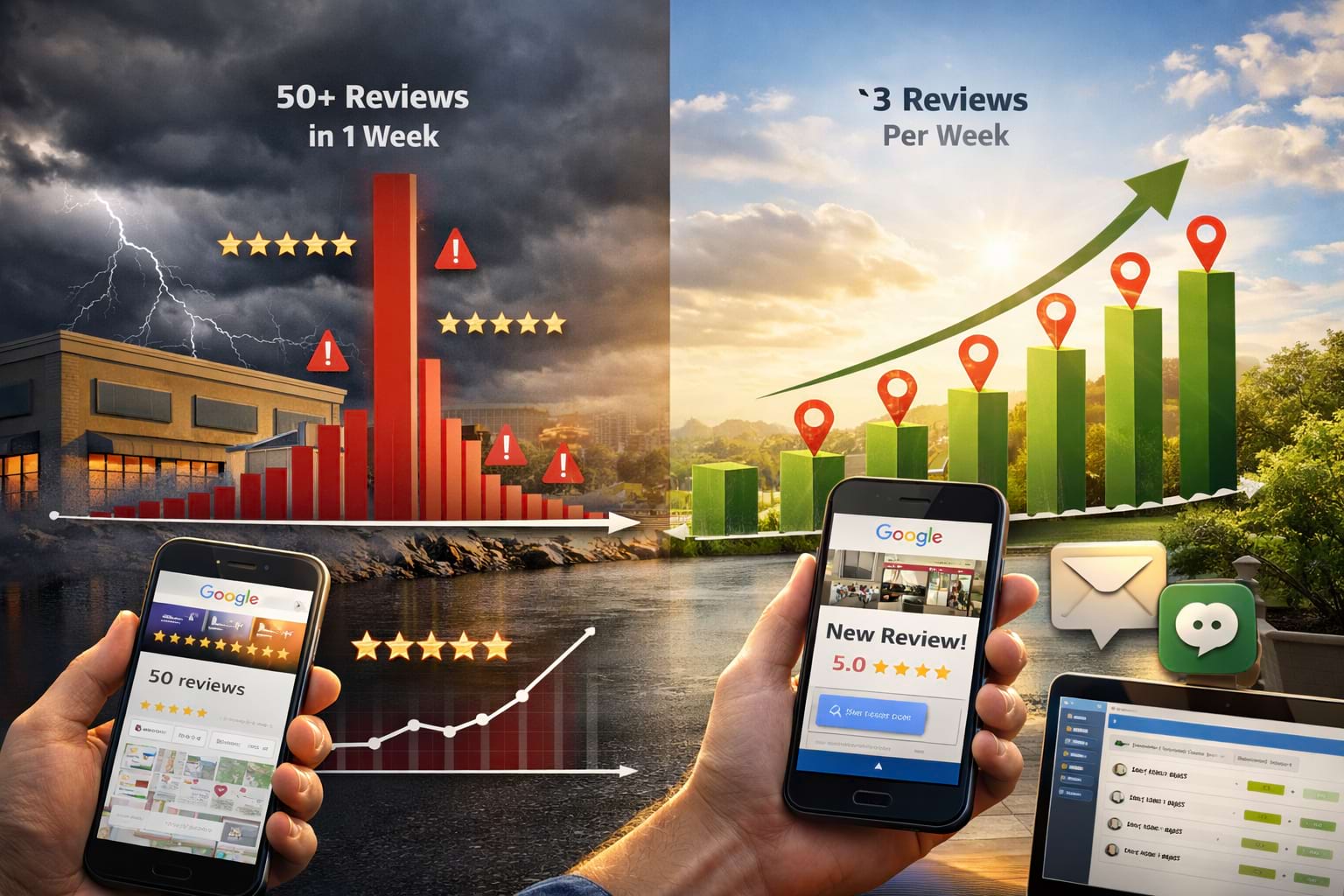
What nobody tells you about how to generate Google reviews is that the rate at which you get them matters. Google’s algorithm is innovative. A business with zero reviews for two years that suddenly gets 50 five-star reviews in one week looks suspicious. It’s a massive red flag for fake or incentivized reviews. Don’t you think so?
Your goal isn’t a one-time blast. It’s to build a system that generates a steady, natural flow of reviews over time. Incorporating this into your reputation management and social media strategy ensures long-term success; one to three new reviews every week is far more powerful and trustworthy than 20 reviews all at once, followed by months of radio silence.
This is where automation, when done right, becomes your best friend. Use your CRM, email marketing software, or a reputation management tool to create a simple workflow:
- Trigger: Customer transaction is completed / appointment is finished.
- Delay: Wait for the “moment of peak happiness.” This could be 1 hour for a restaurant or 3 days for an e-commerce purchase.
- Action: Send a personalized review request via email or SMS.
- Follow-up (Optional): A single, gentle reminder 5-7 days later if no review has been left. Just don’t harass your customers, okay?
This systematic approach ensures a consistent “review velocity” that looks natural to Google and continuously feeds your business’s online presence with fresh social proof.
Real-World Impact: Case Studies in Turning Reviews into Revenue
Let’s see how this works in the real world. Generating positive Google reviews is one thing; generating reviews that actively contribute to your bottom line is another. That’s where the magic happens!
Case Study 1: Oak & Ember Bistro Boosts High-Profit Dish Sales by 23%
The Problem: Oak & Ember, a local restaurant, had a decent 4.2-star rating, but their reviews were, well, generic. Comments like “good food” and “nice place” didn’t help them stand out or sell their higher-margin signature dishes.
The Strategy: They changed their review request process. Instead of a generic ask on the receipt, servers were trained to say, “I saw you really enjoyed the seared scallops! That’s our chef’s specialty. If you have a moment later, a quick mention of them in a Google review would mean the world to our kitchen team.” They paired this verbal prompt with a QR code on the bill that linked directly to the Google review page.
The Result: Within three months, the number of reviews mentioning specific dishes increased by 300%. They now had a wealth of content like, “You HAVE to try the seared scallops, they were the best I’ve ever had!” They featured these glowing testimonials on their menu and website next to the dish. Sales of their signature dishes, which carried a higher profit margin, increased by 23% over the next six months. The reviews weren’t just ratings; they were targeted marketing copy written by their own customers. Following a business listing guide for boosting local business visibility can lead to precisely these kinds of results. How cool is that?
Case Study 2: Precision Plumbing Pros Increases Booking Conversions by 18%
The Problem: Precision Plumbing Pros was a new service provider competing against established local businesses. They were often told their prices were higher, and they struggled to communicate the value behind their premium cost (uniformed, background-checked technicians, clean-up guarantees, etc.).
The Strategy: They implemented an automated SMS review request that went out 2 hours after a job was marked complete. The key was the framing: “Hi [Customer Name], we hope our technician left your home cleaner than we found it! Could you share your experience on Google to help your neighbors know what to expect? [Link]”
The Result: This simple prompt guided customers to talk about the very things that justified the higher price. They started getting reviews that said, “Not the cheapest, but worth every penny. Mark was so professional and left zero mess.” and “So reassuring to have a uniformed tech who was clearly vetted.” They then trained their sales team to say, “I know our quote might seem high, but I encourage you to read our Google reviews. Our customers consistently say our professionalism and cleanliness are why they choose us.” This approach boosted their booking conversion rate from prospects who initially questioned the price by 18% in one quarter. The reviews directly addressed and overcame the primary sales objection. Amazing, right?

Your Masterclass in Review Response: Handling the Good, Bad, and Ugly
Generating reviews is only half the battle. Your responses are public and just as important as the original review. Responding shows you’re engaged, you care about customer feedback, and you’re a real human being. In fact, many consumers trust reviews more when they see a business actively responding. It just makes sense.
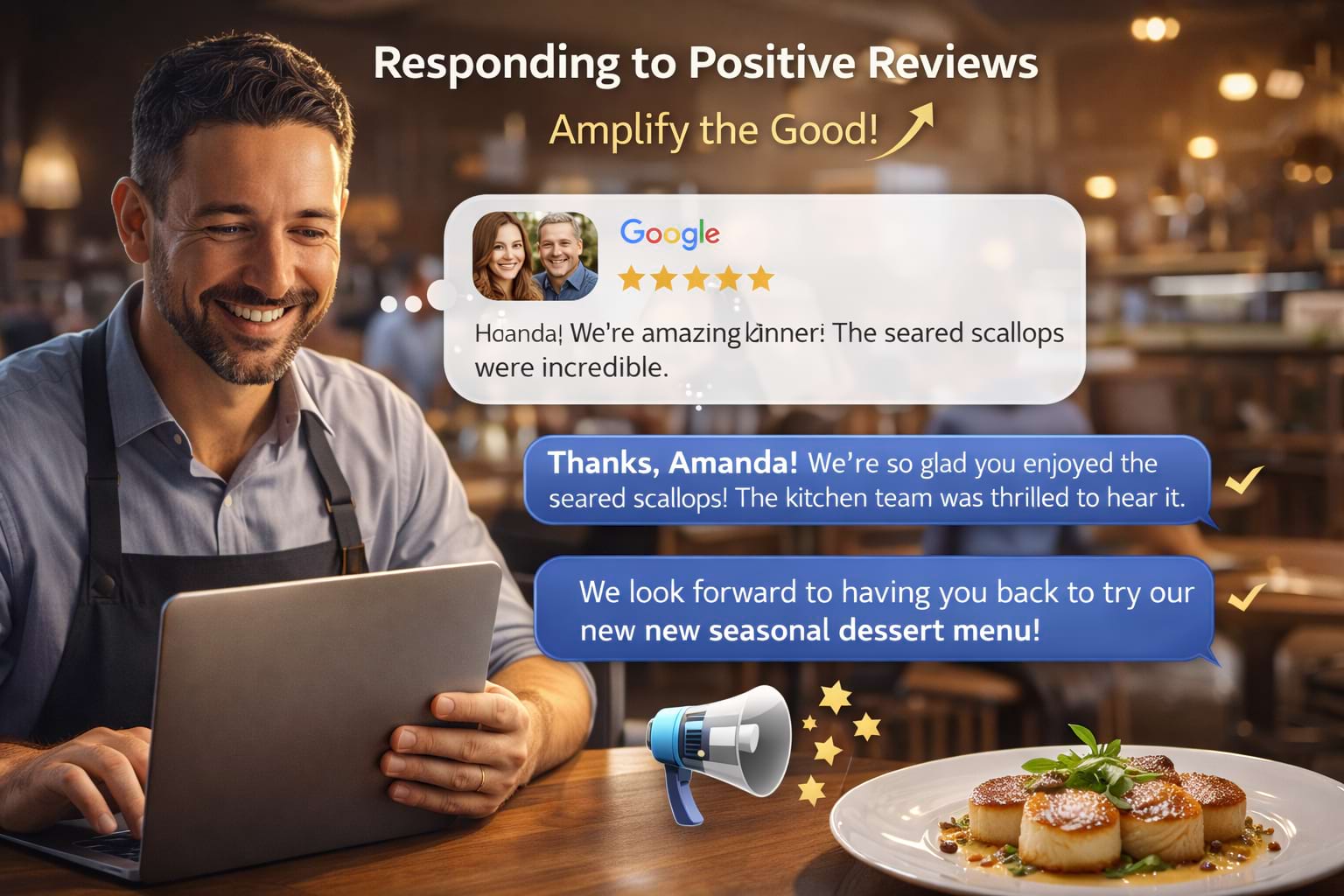
Responding to Positive Reviews: Amplify the Good!
Avoid the generic “Thanks for the review!” It’s a wasted opportunity. You’ve got to amplify that positive sentiment!
- Personalize it: Use their name.
- Reference their comment: “We’re so glad you enjoyed the seared scallops! The kitchen team was thrilled to hear it.”
- Add a little marketing: “We look forward to having you back to try our new seasonal dessert menu!”
This makes the original reviewer feel heard and adds valuable keywords and context for future readers. Win-win!
The 4-Step Framework for Responding to Negative Reviews: Turn Critics into Champions
A negative review isn’t a crisis; it’s an opportunity. A well-handled response can actually win you more customers than a five-star review can. Don’t be defensive. Just be professional.
- Acknowledge and Apologize: Thank them for the feedback and apologize that their experience didn’t meet expectations. Even if you think they’re wrong, apologize for their feelings. “We’re so sorry to hear your experience wasn’t up to our usual standards.”
- Take Responsibility (Not Blame): Show accountability. “We pride ourselves on prompt service, and it’s clear we missed the mark here.”
- Offer to Make it Right Offline: Don’t get into a public back-and-forth. Provide a direct contact. “My name is Sarah, I’m the manager. I’d appreciate the chance to learn more and make this right. Could you please email me at sarah@yourbusiness.com?”
- Keep it Short and Professional: No excuses. No long stories. Just a calm, professional response that shows you’re on top of it.
This approach shows prospective customers that if something does go wrong, you’ll be there to fix it. That’s a powerful selling point, wouldn’t you agree?
Warning: The High Cost of Buying Google Reviews (Don’t Even Think About It)
Let’s get this out of the way. Should you buy Google reviews? Absolutely not. It’s a short-sighted, dangerous, and ultimately useless tactic. Here’s why:
- It’s Against Google’s Policy: Google is actively fighting fake engagement. Getting caught (and you will) can lead to having your reviews wiped out or even your entire Google Business Profile suspended. Is it really worth risking your business’s entire online presence?
- It’s Often Illegal: The FTC considers this deceptive advertising and can and does levy hefty fines. Review boosting isn’t a grey area; it’s a violation.
- Customers Can Smell a Fake: Today’s consumers are savvy. They can spot fake reviews from a mile away. They’re often poorly written, overly generic (“Great service!”), and posted by profiles with no other review history. Seeing fake reviews instantly destroys your credibility.
- You Miss Out on Real Feedback: The whole point of a feedback loop is getting real information to improve your business. Fake reviews give you nothing. You’re paying for lies that prevent you from fixing real problems.
The risk isn’t worth the reward. Focus on earning genuine reviews from real customers. It’s the only sustainable path to building a powerful online reputation. Period.
The Ultimate Feedback Loop: Turning Customer Insights into Your Greatest Asset
The most successful businesses don’t just collect reviews; they integrate them. They build a flywheel where customer feedback directly fuels business improvement, which in turn generates even better customer feedback. Pretty neat, huh?
Here’s how to create your own feedback loop:
- Collect: Use the systematic strategies we’ve discussed to generate Google reviews consistently.
- Analyze: Once a month, sit down and read through all your new reviews. Look for patterns. Are multiple people mentioning the same excellent employee? Give that person a bonus! Are a few people complaining that your phone lines are always busy? It’s time to look at a new phone system.
- Act: Implement changes based on the feedback. Fix the problems and double down on what people love.
- Announce: Use your review responses and even Google Posts on your GBP to talk about the changes you’ve made. For example: “Thanks for your feedback about our wait times! We’ve now implemented a new reservation system to help serve you better.”
This process transforms your business’s online reputation from a passive score into an active, dynamic conversation. It shows customers you listen, you care, and you’re constantly improving. That’s a brand people want to be loyal to.
Build a Sustainable Review Generation System—Starting Now
Stop thinking about how to get “more” reviews and start building a review-generation system. One that is proactive, consistent, and focused on quality over sheer quantity.
Your Google reviews page should be your single most significant marketing asset. It’s a living, breathing testament to the value you provide, written by the people who matter most: your customers. By making it easy to leave a review, asking at the right moment, and engaging with all feedback, you’re not just chasing stars. You’re building trust, driving conversion rate optimization, and creating a business that stands the test of time.
FAQs About Boosting Google Reviews
Q1: How quickly can I start seeing more Google reviews?
With a strategic approach, you can start seeing an increase in reviews within a few days to a week, especially if you implement automated requests at the ‘moment of peak happiness.’ Consistency is key to long-term growth, aiming for 1-3 new reviews per week.
Q2: Is it okay to offer incentives for Google reviews?
No, offering direct incentives (like discounts or free products) in exchange for Google reviews is against Google’s policies and can lead to penalties, including review removal or profile suspension. Focus on providing excellent service that naturally encourages positive feedback.
Q3: What’s the best way to ask for a Google review?
The best way is to ask at the ‘moment of peak happiness’ using a direct Google review link. Channels like personalized SMS messages (98%+ open rates) or post-service emails are highly effective. For in-person businesses, strategically placed QR codes can also work wonders.
Q4: How often should I respond to reviews?
You should aim to respond to every review, both positive and negative. Responding to positive reviews amplifies goodwill and adds marketing value, while thoughtfully addressing negative reviews demonstrates care and professionalism, turning a critic into a loyal customer.
Q5: What should I do if I get a fake or unfair negative review?
First, respond professionally using the 4-step framework (acknowledge, take responsibility, offer to resolve offline, keep it short). If you genuinely believe the review is fake or violates Google’s policies, you can flag it for removal through your Google Business Profile dashboard. However, Google only removes reviews that clearly violate its content policies.
Q6: Can I use third-party tools to help manage my Google reviews?
Yes, many reputation management tools can help automate review requests, monitor new reviews, and streamline your response process. These tools can be invaluable for maintaining consistent review velocity and efficiently managing your online reputation.
Overwhelmed by Your Online Reputation?
Building a 5-star reputation takes time and a consistent strategy. If you’re ready to turn your Google reviews into a powerful engine for business growth but don’t have the time to manage them yourself, ReputationPrime is here to help.
Our experts handle everything from optimizing your profiles and generating a steady stream of positive reviews to crafting professional responses that win customers. Schedule a free consultation today, and let’s build a reputation that drives real results for your business.

