

- Discover how Google reviews for business directly influence customer trust, local search rankings, and sales growth.
- Learn effective strategies to generate more genuine reviews, including using direct links, QR codes, and personalized requests.
- Understand best practices for managing both positive and negative reviews to build a trustworthy online reputation and attract new customers.
How Google Reviews for Business Directly Impact Sales
Let’s be real for a second. Your potential customers often trust total strangers on the internet more than they trust your own marketing. A recent BrightLocal survey found a whopping 89% of consumers check reviews before buying anything, and nearly half trust those reviews as much as a personal recommendation from a friend. Seriously, think about that: a review from “Dave B.” in some other city can hold the same weight as advice from their best buddy.
This isn’t just a fun fact; it’s the new reality for local businesses. If your Google reviews for business strategy basically boil down to hoping for the best, you’re not just losing ground; you’re practically invisible. The difference between a 3.9-star rating and a 4.6-star rating isn’t just a few points; it’s the difference between a phone that rings off the hook and one that collects dust.
Here’s the real problem: most business owners treat Google reviews for business like an annoying chore, something to glance at once a month. Big mistake! Your reviews are actually one of your most active, powerful, and cost-effective marketing tools. Isn’t it time you started treating them that way? At ReputationPrime, we help businesses harness the true power of their Google reviews to boost trust, attract more customers, and grow their success.

Why Your Business Is Invisible Without a Winning Review Strategy
Let’s be blunt: a weak or nonexistent Google Business Profile with few reviews is a major red flag to potential customers. It screams that you’re either brand new, unpopular, or don’t care enough to manage your online presence. None of those are good looks, are they?
So, what’s really at stake here?
- Dominate Local Search: Google’s local search algorithm absolutely loves fresh, frequent, and positive reviews. A steady stream of good feedback tells Google you’re relevant, active, and a quality result for folks searching for your services. This directly impacts your ranking on Google Maps and in that super-important “Local 3-Pack.” More and better reviews can literally lift your business name right above your competitors, like “Tony’s Pizza” appearing above “Pizza Palace” with a higher average rating and more recent reviews.
-
Build Instant Trust: Reviews are basically digital word-of-mouth. They provide social proof that you actually deliver on your promises. A collection of genuine reviews written by real people builds a layer of online reputation management in digital marketing trust that no advertisement, no matter how clever, could ever buy. Customers feel like they’re making a safer choice when they pick the business with a proven track record.
- Boost Customer Conversions: High ratings don’t just get you seen; they get you chosen. BrightLocal found that jumping from a 3-star to a 5-star rating can net a business 25% more clicks from Google. More clicks mean more website traffic, more phone calls, and ultimately, more customers walking through your door or clicking “buy.”
Your Playbook: How to Generate a Flood of Genuine Reviews
Just hoping customers will leave a review? That’s not a strategy, is it? You need a proactive system. The trick is to make it ridiculously easy for happy customers to share their feedback. Most people who’ve had a good experience are totally willing to write a review; they just forget or don’t know how.
First things first, you need your unique review link. Don’t send people to Google and expect them to find you. Give them a direct path.
- Hop into your Google Business Profile Manager.
- On the home card, look for the “Get more reviews” panel.
- Click “Share review form.” A link will pop up for you to copy.
This link takes a person straight to the 5-star rating and comment box for your business. No searching, no confusion. Now, how do you actually use it?
The Top 4 Proven Ways to Request Reviews
Don’t just stick to one method. Try a multi-channel approach to catch customers wherever they’re most comfortable. The goal is to weave the “ask” into your process so it feels like a natural final step.
Case Study: How “The Daily Grind” Brewed Up a 25% Traffic Increase
The Daily Grind, a local coffee shop, was kind of stuck. They made great coffee, sure, but they had a pretty mediocre 3.9-star rating from just 45 reviews, all old and uninspired. Newcomers would often just pick the Starbucks down the street with its 4.4-star rating and 200+ reviews. So the owner, Sarah, decided it was time to maintain her online reputation and get serious about her Google Business Reviews.
She rolled out a two-part strategy. First, she put a small sign with a QR code right at the register that read: “Love our brew? Scan here to leave a review!” Baristas were trained to point it out to friendly regulars, especially after receiving compliments. Second, for customers in their loyalty program, she set up an automated email that went out two hours after their purchase, simply saying: “Thanks for stopping by, [Name]! We’d be so glad if you shared your experience on Google.”
The results were stunning! Within three months, The Daily Grind went from 45 reviews to over 150. Their rating shot up to 4.6 stars. Even better, their profile views from Google Maps discovery searches jumped by 25%, which led to a noticeable increase in new foot traffic, especially during peak hours. Sarah really turned a passive weakness into an active customer-generation machine.
The Damage Control Doctrine: Turning Negative Reviews into Trust Wins
Let’s get one thing straight: you will get a negative review. It’s just going to happen. The difference between a great business and a mediocre one isn’t about avoiding bad reviews; it’s all about how you handle them. Believe it or not, a well-handled negative review can actually build more trust than a dozen 5-star raves.
Here’s your 3-step process for responding to negative feedback:
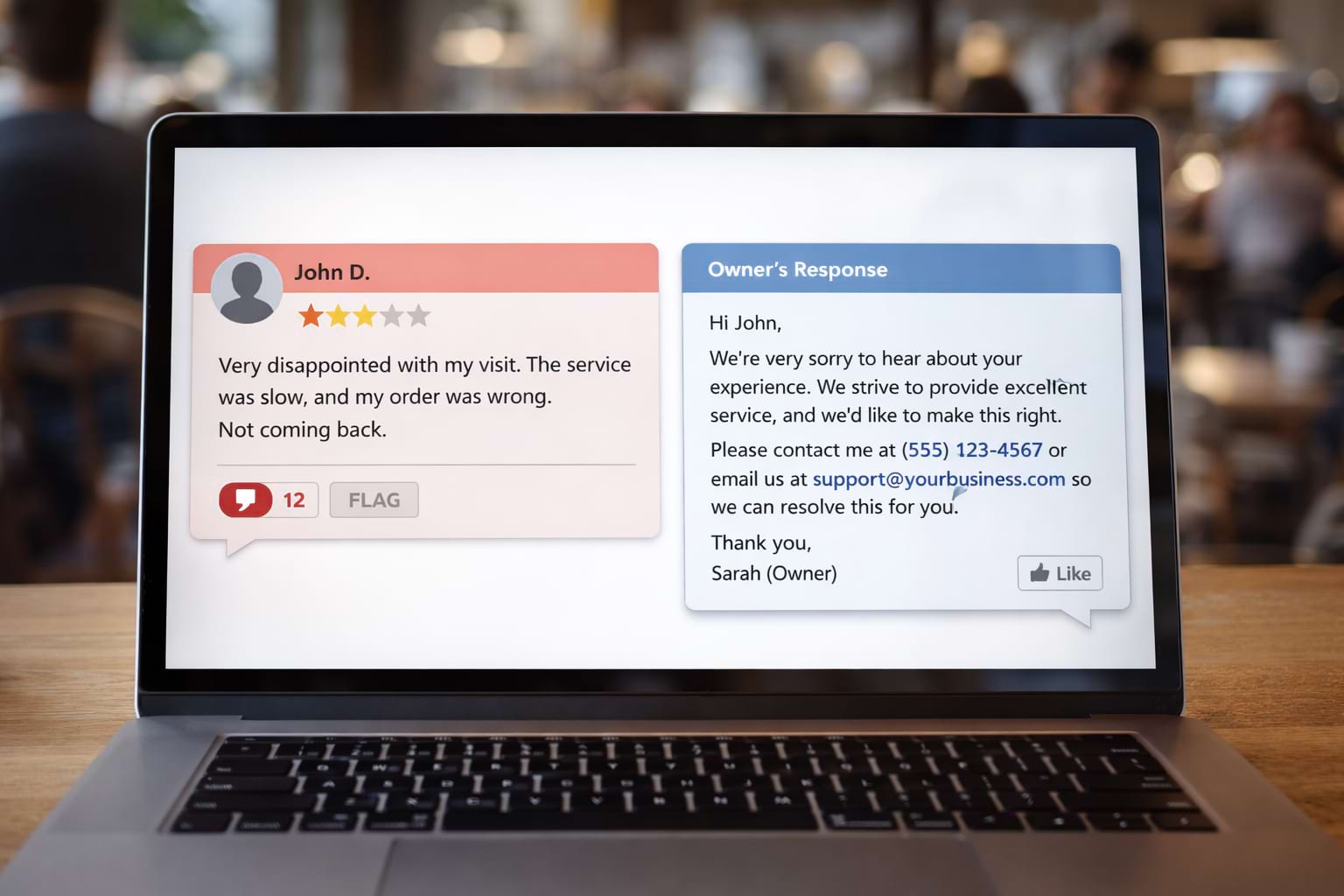
- Respond Quickly and Publicly. Aim for under 24 hours. This shows you’re paying attention. Acknowledge their frustration and thank them for the feedback, even if it stings. Never, ever get defensive.
- Apologize and Empathize. Don’t admit fault if it’s not yours, but you can always apologize for their bad experience. A simple “I’m sorry to hear your experience didn’t meet your expectations” goes a long, long way.
- Take it Offline. Provide a direct contact method (phone number or email) to resolve the issue privately. This shows you’re serious about fixing it and keeps things from turning into a public back-and-forth. For example: “We want to make this right. Please call me directly at [Your Phone Number] or email [Your Email Address] so I can address your concerns personally.”
What about burying that bad review? A common question is, “How many 5-star reviews do I need to negate a 1-star review?” The math is simple, but the impact is profound. If you have ten 5-star reviews, your average is 5.0. One 1-star review drops you to 4.6. To get back to a 4.8 average, you’d need ten more 5-star reviews. The lesson? It’s far easier to keep a high rating than to fix a damaged one. Isn’t that wild?
The Red Lines: Google Review Rules That Can Get You Banned
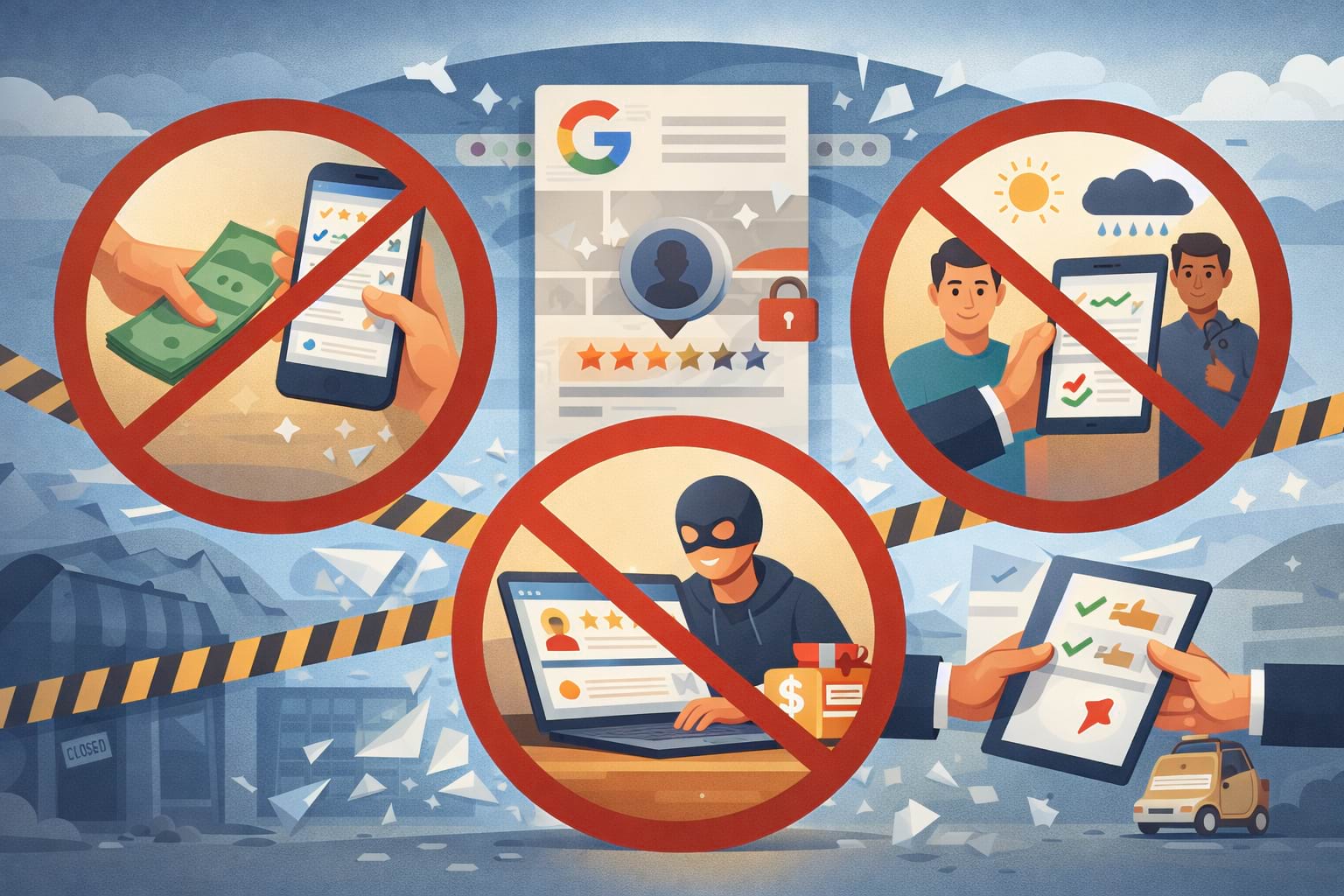
In the quest for more reviews, it can be super tempting to cut corners. Don’t do it. Reputation management on social media matters more than ever—Google is smarter than you think, and the penalties are severe, sometimes including having your entire review section wiped out or even your business profile suspended.
Here’s what you must NEVER, ever do:
- Is review boosting illegal? While not technically “illegal” in a criminal sense, buying fake reviews violates Google’s terms of service and can have serious consequences. It’s essentially deceptive marketing. Google’s algorithm is really good at spotting patterns of spam and inappropriate content. Seriously, don’t risk it.
- Can I get paid to write reviews? Absolutely not. If you’re a consumer, accepting payment to write a review (positive or negative) is unethical and violates platform policies. If you’re a business, offering incentives like discounts, gift cards, or free products in exchange for reviews is strictly prohibited.
- Review Gating: The practice of screening customers and asking only the happy ones to leave a review. This is also against Google’s policies. You have to give all customers the same opportunity to provide feedback.
Just stick to asking for legitimate reviews from actual customers. It’s a slower, more honest process, but it builds a foundation of trust that you simply can’t fake.
The 4.7-Star Sweet Spot: My Contrarian Take on Perfection
Here’s something nobody really tells you: a perfect 5.0-star rating can actually be suspicious. In a world full of online skepticism, customers know that no business is perfect. A flawless record can sometimes feel artificial or look like you’ve been deleting bad reviews or buying good ones.
The sweet spot for consumer trust is actually somewhere between 4.6 and 4.8 stars. Why? This rating just feels more authentic. It implies the business is excellent, but also that they’re real. It suggests they have a high volume of reviews, including a few less-than-perfect ones, and, crucially, that they’ve responded to them professionally—key principles covered in the complete guide to managing and growing an online business. Doesn’t that make sense?
So, don’t panic over a 4-star or even a 3-star review if you’ve handled it well. These little blemishes, when addressed with grace, prove you’re an authentic, responsive company that truly cares about customer satisfaction. They actually make your 5-star reviews seem even more credible. So stop chasing that mythical 5.0 and start focusing on building a real, responsive, and trustworthy review profile instead.
Turn Reviews Into Trust, Traffic, and New Customers
Your Google reviews are a living, breathing part of your business. They’re your digital curb appeal, your 24/7 sales team, and your direct line to the customer’s personal opinion. Stop treating them as an afterthought.
Start today. Create your direct review link. Pick just one strategy from the playbook to SMS, email, or a simple in-person ask and implement it this week. Train your team. Start responding to every single review, good or bad. Don’t just manage your reviews; lead them!
By shifting from a passive observer to an active participant in your online reputation, you’ll do more than just boost a number. You’ll build unbreakable trust, attract a flood of new customers, and create a competitive advantage your rivals just can’t easily replicate—especially when paired with a local SEO audit that unlocks new business. Take control of your online story and watch your business thrive!

Google Reviews FAQs
Q1: Why are Google reviews so important for my business?
Q2: How can I get more Google reviews for my business?
The most effective method is to ask customers proactively. Share a direct review link via SMS, email, or QR codes, and train staff to ask in person after a positive experience. The easier and more frictionless the process, the more reviews you’ll receive.
Q3: Should I respond to every Google review?
Yes. Responding to all reviews—positive and negative—shows engagement, appreciation for feedback, and commitment to customer experience. Thank customers for positive reviews, and address negative ones promptly with empathy and professionalism.
Q4: Can I offer incentives for Google reviews?
No. Offering incentives such as discounts, free products, or gift cards in exchange for reviews violates Google’s policies. This can result in review removal or suspension of your Google Business Profile. Always request honest, unbiased feedback.
Q5: What should I do about a negative Google review?
Respond quickly—ideally within 24 hours—publicly and professionally. Apologize for the experience, show empathy, and invite the reviewer to continue the conversation privately via phone or email. This demonstrates accountability and strong customer service.
Q6: Is a perfect 5.0-star rating always the best?
Not necessarily. While high ratings are valuable, a perfect 5.0 can appear unrealistic. Ratings between 4.6 and 4.8 often feel more authentic, signaling genuine customer experiences and professionally handled issues—building greater trust and credibility.

